The G7, International Law and me – This was the theme of the Café débat on the 18th of June 2026 at the Maison du quartier des Eaux-Vives with around 15 participants. Dr Susanne Schmelter provided background information and facilitated a discussion on the question: how could Geneva better host such a summit respectively the protests that accompany it?[1]
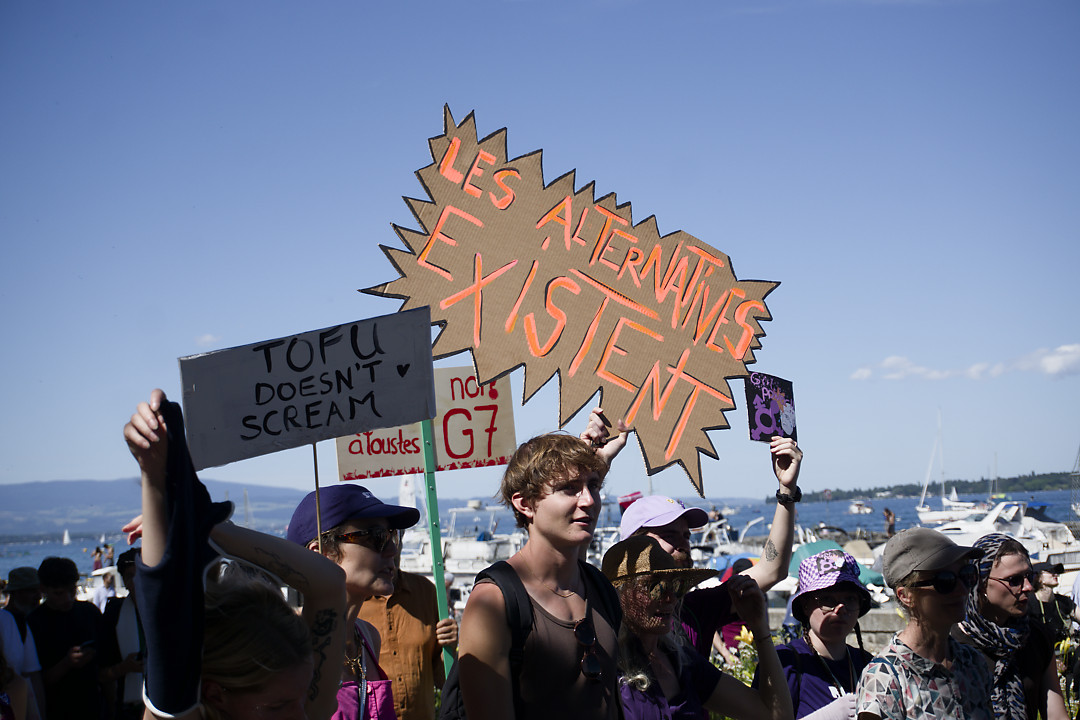
Manifestation NoG7 le 14 june 2026 Geneva. Photo: Susanne Schmelter
This report sums up[2] key elements of the contextual input: the history of G7 summits, the protests they have generated, international law, and Geneva’s role as the seat of multilateral institutions, in particular the Human Rights Council.
The G7
In the 1970s, the oil crisis and the collapse of the fixed exchange rate system (Bretton Woods system) led to increased volatility in the global economy. In response, the major economic powers of the time began holding summits to coordinate their policies outside established institutions such as the United Nations.
When the group was founded in 1975, it brought together six major economies: France, Germany, Italy, Japan, the United Kingdom, and the United States. Canada joined the following year.
After the end of the Cold War, Russia took part in the discussions and became a member of the G8 from 1998 until 2014.
Since then, the G7 has ceased to represent the world’s largest economies on its own. Other groups and networks, particularly the BRICS (Brasil, Russia, India, China, South Africa), have emerged to coordinate economic and political interests.
Its Role
Originally, the purpose of the summits was to provide an informal setting for economic coordination and stabilisation. However, in the context of financial market liberalisation and the dominance of neoliberal economic thinking, few regulatory mechanisms were established. Over time, the agenda expanded to include geopolitical, environmental, and development issues, without systematically addressing growing market volatility or widening economic inequalities.
One of the few moments when these summits had particularly tangible political consequences concerned the management of developing countries’ debt under the 1989 “Washington Consensus.” The so promoted austerity and privatisation policies triggered deep cuts to public services, severely degrading the social, health, and education systems infrastructure in many affected countries.
The Protests
The central criticism is that major economic powers meet outside the United Nations framework to advance their interests without genuine democratic legitimacy or transparency in their decision-making processes.
The first organised mobilisation took place in 1984 with “The Other Economic Summit” in London.
The first large-scale demonstration followed in 1985 in Bonn, Germany.
The nature and scale of the protests have always reflected the political context of the host country. Some summits have generated far greater mobilisation than others, often combining counter-summits with public demonstrations.
Although the legitimacy of the G7 itself remains the main focus of criticism, the issues raised have been diverse, including migration, development, debt relief, environmental protection, and many others.
Debates over the legitimacy of violence—whether by some protesters or by the police—have regularly accompanied these mobilisations.
Various efforts have also been made to involve civil society more closely in summit discussions. However, the experience of social movements suggests that even the most ambitious dialogue mechanisms still require sustained public pressure in order to produce meaningful outcomes.[3]
International Law
International law provides the legal framework that all United Nations member states are expected to respect. Repeated neglect by some states to fulfil their obligations—particularly with regard to the prohibition against the threat or use of force in international relations (Article 2(4) of the United Nations Charter)—together with the absence of a global executive authority capable of consistently enforcing these rules, have contributed to an increasing number of deliberate violations of international law.
The multilateral institutions based in Geneva also operate within this international legal framework. Their diversity reflects the broad range of international cooperation, including the UNHCR, the WHO, the ILO, the Human Rights Council, the International Telecommunication Union (ITU), the World Meteorological Organization (WMO), and many others.
Geneva
After New York, which hosts the United Nations Security Council and General Assembly, Geneva is the second most important centre of the UN system. While New York is home to the UN’s principal political bodies, Geneva notably hosts the Human Rights Council.
Geneva is therefore a major hub for international civil society. Representatives of civil society organisations from around the world come to Geneva to participate in Human Rights Council sessions. In addition, many international NGOs maintain offices in Geneva, contributing to a rich ecosystem of associations and non-governmental organisations that has developed around the international institutions.
Moreover, unlike the United States, Switzerland—as a small country—often relies on its neutrality to offer its expertise in mediation and dialogue facilitation.
And Us?
These aspects led to the discussion about alternatives to the heavily securitised response to the protests. The debate moved between a desire to better understand the mechanisms of international politics and a search for personal responses to these global challenges. Particular emphasis was placed on the local level, where individuals have greater opportunities to make a meaningful difference.
The welcoming atmosphere, facilitated by cultural mediator Karine Ben Faour, enabled the kind of discussion one would like to see more often: friendly, respectful, and open to the exchange of different perspectives. The experience highlighted the importance of creating more informal and personal spaces where people can come together to reflect on international politics in Geneva.
[1] As the large-scale security measures surrounding the G7 summit in Evian and its contestation had left strong impressions on Geneva residents, the participants first shared their varying reflections in view of the extensively barricaded city. The viewpoints expressed during the following discussion are not detailed in this report, even though they opened up interesting avenues for further reflection.
[2] This report is based on personal presentation notes and a working draft. It has been edited (and translated from French to English) with ChatGPT-5.5; final review by the author.
[3] On the role of the G7 summits and the protest movements: Wahl, Peter. 2015a. ‘Die G7 und die Gipfelproteste’. Brot für die Welt, May 13. https://www.brot-fuer-die-welt.de/blog/2015-die-g7-und-die-gipfelproteste/. Wahl, Peter. 2015b. ‘G7 in der Identitätskrise’. Brot für die Welt, March 25. https://www.brot-fuer-die-welt.de/blog/2015-g7-in-der-identitaetskrise/.

The G7, International Law and me – This was the theme of the Café débat on the 18th of June 2026 at the Maison du quartier des Eaux-Vives with around 15 participants. Dr Susanne Schmelter provided background information and facilitated a discussion on the question: how could Geneva better host such a summit respectively the protests that accompany it?[1]
Manifestation NoG7 le 14 june 2026 Geneva. Photo: Susanne Schmelter
This report sums up[2] key elements of the contextual input: the history of G7 summits, the protests they have generated, international law, and Geneva’s role as the seat of multilateral institutions, in particular the Human Rights Council.
The G7
In the 1970s, the oil crisis and the collapse of the fixed exchange rate system (Bretton Woods system) led to increased volatility in the global economy. In response, the major economic powers of the time began holding summits to coordinate their policies outside established institutions such as the United Nations.
When the group was founded in 1975, it brought together six major economies: France, Germany, Italy, Japan, the United Kingdom, and the United States. Canada joined the following year.
After the end of the Cold War, Russia took part in the discussions and became a member of the G8 from 1998 until 2014.
Since then, the G7 has ceased to represent the world’s largest economies on its own. Other groups and networks, particularly the BRICS (Brasil, Russia, India, China, South Africa), have emerged to coordinate economic and political interests.
Its Role
Originally, the purpose of the summits was to provide an informal setting for economic coordination and stabilisation. However, in the context of financial market liberalisation and the dominance of neoliberal economic thinking, few regulatory mechanisms were established. Over time, the agenda expanded to include geopolitical, environmental, and development issues, without systematically addressing growing market volatility or widening economic inequalities.
One of the few moments when these summits had particularly tangible political consequences concerned the management of developing countries’ debt under the 1989 “Washington Consensus.” The so promoted austerity and privatisation policies triggered deep cuts to public services, severely degrading the social, health, and education systems infrastructure in many affected countries.
The Protests
The central criticism is that major economic powers meet outside the United Nations framework to advance their interests without genuine democratic legitimacy or transparency in their decision-making processes.
The first organised mobilisation took place in 1984 with “The Other Economic Summit” in London.
The first large-scale demonstration followed in 1985 in Bonn, Germany.
The nature and scale of the protests have always reflected the political context of the host country. Some summits have generated far greater mobilisation than others, often combining counter-summits with public demonstrations.
Although the legitimacy of the G7 itself remains the main focus of criticism, the issues raised have been diverse, including migration, development, debt relief, environmental protection, and many others.
Debates over the legitimacy of violence—whether by some protesters or by the police—have regularly accompanied these mobilisations.
Various efforts have also been made to involve civil society more closely in summit discussions. However, the experience of social movements suggests that even the most ambitious dialogue mechanisms still require sustained public pressure in order to produce meaningful outcomes.[3]
International Law
International law provides the legal framework that all United Nations member states are expected to respect. Repeated neglect by some states to fulfil their obligations—particularly with regard to the prohibition against the threat or use of force in international relations (Article 2(4) of the United Nations Charter)—together with the absence of a global executive authority capable of consistently enforcing these rules, have contributed to an increasing number of deliberate violations of international law.
The multilateral institutions based in Geneva also operate within this international legal framework. Their diversity reflects the broad range of international cooperation, including the UNHCR, the WHO, the ILO, the Human Rights Council, the International Telecommunication Union (ITU), the World Meteorological Organization (WMO), and many others.
Geneva
After New York, which hosts the United Nations Security Council and General Assembly, Geneva is the second most important centre of the UN system. While New York is home to the UN’s principal political bodies, Geneva notably hosts the Human Rights Council.
Geneva is therefore a major hub for international civil society. Representatives of civil society organisations from around the world come to Geneva to participate in Human Rights Council sessions. In addition, many international NGOs maintain offices in Geneva, contributing to a rich ecosystem of associations and non-governmental organisations that has developed around the international institutions.
Moreover, unlike the United States, Switzerland—as a small country—often relies on its neutrality to offer its expertise in mediation and dialogue facilitation.
And Us?
These aspects led to the discussion about alternatives to the heavily securitised response to the protests. The debate moved between a desire to better understand the mechanisms of international politics and a search for personal responses to these global challenges. Particular emphasis was placed on the local level, where individuals have greater opportunities to make a meaningful difference.
The welcoming atmosphere, facilitated by cultural mediator Karine Ben Faour, enabled the kind of discussion one would like to see more often: friendly, respectful, and open to the exchange of different perspectives. The experience highlighted the importance of creating more informal and personal spaces where people can come together to reflect on international politics in Geneva.
[1] As the large-scale security measures surrounding the G7 summit in Evian and its contestation had left strong impressions on Geneva residents, the participants first shared their varying reflections in view of the extensively barricaded city. The viewpoints expressed during the following discussion are not detailed in this report, even though they opened up interesting avenues for further reflection.
[2] This report is based on personal presentation notes and a working draft. It has been edited (and translated from French to English) with ChatGPT-5.5; final review by the author.
[3] On the role of the G7 summits and the protest movements: Wahl, Peter. 2015a. ‘Die G7 und die Gipfelproteste’. Brot für die Welt, May 13. https://www.brot-fuer-die-welt.de/blog/2015-die-g7-und-die-gipfelproteste/.Wahl, Peter. 2015b. ‘G7 in der Identitätskrise’. Brot für die Welt, March 25. https://www.brot-fuer-die-welt.de/blog/2015-g7-in-der-identitaetskrise/.